
Cloud ERP vs On-Premise ERP:
Which ERP Is Right for Your Business?
Choosing the right ERP system is a crucial decision for any business. One of the biggest questions companies face today is whether to choose Cloud ERP or On-Premise ERP. Both options have their advantages and limitations, and the right choice depends on your business needs, budget, and future growth plans.
In this guide, we’ll break down the complete comparison between Cloud ERP and On-Premise ERP to help you make an informed decision.
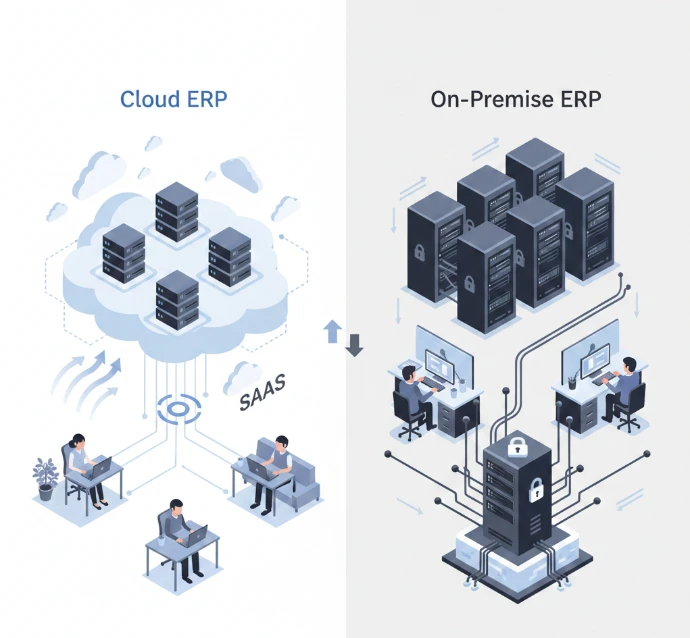
What is Cloud ERP?
Cloud ERP is an enterprise resource planning system hosted on the cloud and accessed through the internet. It is managed by the ERP service provider and does not require businesses to maintain physical servers or infrastructure.
Key Features of Cloud ERP
Accessible anytime, anywhere
Subscription-based pricing
Automatic updates and upgrades
Scalable as your business grows
What is On-Premise ERP?
On-Premise ERP is installed and run on a company’s own servers and infrastructure. The business is responsible for managing hardware, software, security, and updates.
Key Features of On-Premise ERP
Installed locally within the organization
One-time license cost
Full control over data and system
Customization flexibility
Cloud ERP vs On-Premise ERP: Detailed Comparison
1. Cost
Cloud ERP: Lower upfront cost with monthly or yearly subscription fees.
On-Premise ERP: High initial investment for licenses, hardware, and IT staff.
Winner: Cloud ERP (cost-effective for most businesses)
2. Deployment Time
Cloud ERP: Quick deployment, often within weeks.
On-Premise ERP: Can take months due to installation and configuration.
Winner: Cloud ERP
3. Scalability
Cloud ERP: Easily scalable as business needs change.
On-Premise ERP: Scaling requires additional hardware and costs.
Winner: Cloud ERP
4. Maintenance & Updates
Cloud ERP: Handled by the vendor automatically.
On-Premise ERP: Managed internally, requiring IT resources.
Winner: Cloud ERP
5. Data Security
Cloud ERP: Advanced security with encryption, backups, and compliance standards.
On-Premise ERP: Full control over data security but depends on internal capabilities.
Winner: Depends on business preference
6. Customization
Cloud ERP: Limited customization compared to on-premise.
On-Premise ERP: Highly customizable to specific business processes.
Winner: On-Premise ERP
7. Accessibility
Cloud ERP: Accessible from anywhere with internet.
On-Premise ERP: Limited to office network unless remote access is configured.
Winner: Cloud ERP
Comparison Table
| Feature | Cloud ERP | On-Premise ERP |
|---|---|---|
| Upfront Cost | Low | High |
| Deployment Speed | Fast | Slow |
| Scalability | High | Limited |
| Maintenance | Vendor-managed | Self-managed |
| Customization | Moderate | High |
| Accessibility | Anywhere | On-site |
| IT Dependency | Low | High |
Which ERP is Right for Your Business?
Choose Cloud ERP if:
You want lower upfront costs
Your business is growing rapidly
You need remote access
You want minimal IT management
Choose On-Premise ERP if:
You need extensive customization
You have strict data control requirements
You already have strong IT infrastructure
You prefer one-time investment
Both Cloud ERP and On-Premise ERP are powerful solutions, but Cloud ERP is increasingly becoming the preferred choice for modern businesses due to its flexibility, scalability, and cost efficiency. On-Premise ERP still makes sense for organizations with complex customization and strict compliance needs.
Before choosing, analyze your business size, budget, and long-term goals carefully.
FAQs
Q1. Is Cloud ERP safe?
Yes, Cloud ERP providers use advanced security measures like encryption, firewalls, and regular backups.
Q2. Can Cloud ERP be customized?
Yes, but customization is limited compared to On-Premise ERP.
Q3. Which ERP is better for small businesses?
Cloud ERP is usually better due to lower costs and easy scalability.
Q4. Can I migrate from On-Premise to Cloud ERP later?
Yes, many businesses successfully migrate with proper planning.